2026 Top Wheel And Hub Types for Global Buyers?
Global buyers comparing Wheel And Hub products in 2026 face a practical choice: prioritize low weight, durability, serviceability, or total cost. The answer depends on the vehicle, operating conditions, and replacement schedule. Cast-aluminum wheels often suit cost-conscious passenger vehicles. Forged wheels offer high strength at lower weight, but usually cost more. Steel wheels remain a practical option for heavy use. Hub choices matter just as much, from basic hub assemblies to integrated hub-and-bearing units.
The scale is substantial. OICA reported approximately 92.5 million motor vehicles produced worldwide in 2024. That figure describes vehicle production, not wheel or hub sales, so it should not be mistaken for a direct demand forecast. Still, it signals the vast range of vehicles that buyers must support. A city fleet, an off-road operator, and a long-haul truck buyer need different specifications. Small details count: bolt pattern, load rating, bearing design, corrosion protection, and access to replacement parts.
Engineering historian Henry Petroski offers a useful principle: “Science is about knowing; engineering is about doing.” For buyers, that means checking fitment and verified load data, not just comparing attractive catalog images. This guide examines common wheel and hub types, their trade-offs, and the questions worth asking suppliers. Some product descriptions remain confusing. That deserves a closer look. A low purchase price can also hide added maintenance or limited parts availability. The best choice is not always the lightest or cheapest; it is the one that fits the real duty cycle.
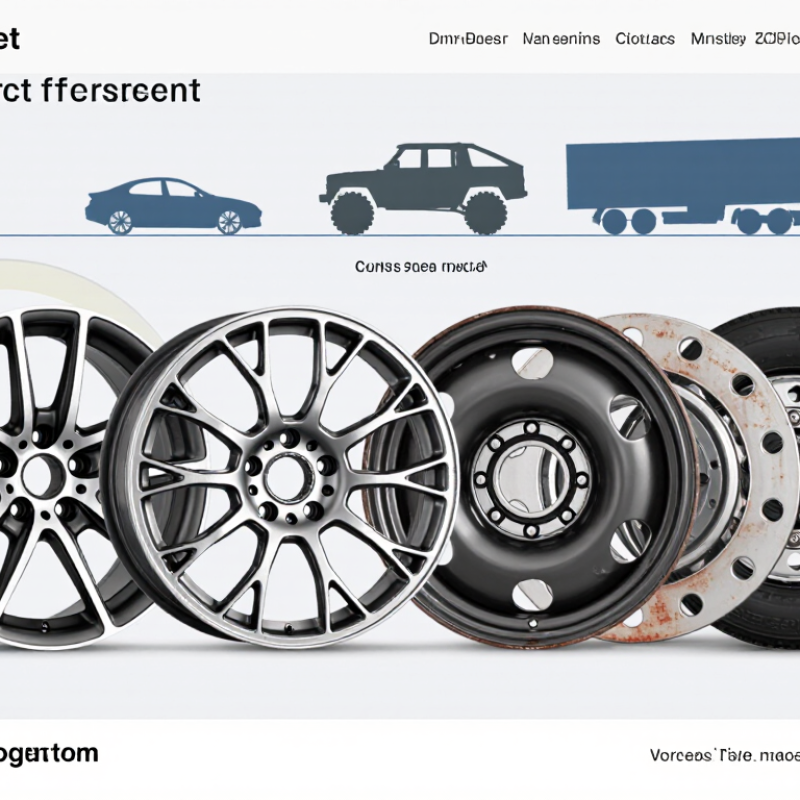
Wheel and Hub Fundamentals: Structure, Function, and Key Terms
A wheel carries the tire and transfers road forces to the vehicle. The hub connects that wheel to the axle or suspension, while its bearings allow rotation with controlled friction. Many modern hub assemblies also include an encoder that supplies wheel-speed signals to vehicle systems. Fit matters.
Key terms describe how the parts meet. The bolt pattern gives the number and spacing of mounting holes; the center bore locates the wheel on the hub. Offset measures the distance between the wheel’s mounting face and its centerline. Load rating indicates the load a wheel is designed to support. These details are not interchangeable, even when two wheels look similar.
The U.S. Department of Energy’s Vehicle Technologies Office reports that reducing a vehicle’s weight by 10% can improve fuel economy by 6–8%. This is a whole-vehicle estimate, not a guaranteed result from lighter wheels alone. SAE International’s J2530 standard specifies performance requirements and test procedures for aftermarket wheels. Buyers should compare specifications with the vehicle maker’s requirements, then verify fitment details. Catalog terminology can still be inconsistent, so checking the measurements directly is worthwhile.
2026 Top Wheel and Hub Types for Global Buyers? — Wheel and Hub Fundamentals: Structure, Function, and Key Terms
| Category | Type or term | Structure | Function and common applications | Key buyer checks |
|---|---|---|---|---|
| Wheel | Stamped steel wheel | A pressed steel center disc is joined to a rolled steel rim. | Common on passenger vehicles, light trucks, and commercial vehicles. Steel construction is generally durable and straightforward to repair, though it is typically heavier than an equivalent aluminum-alloy wheel. | Check the specified diameter and width, bolt pattern, center bore, offset, load rating, brake clearance, and approved tire size. |
| Wheel | Cast aluminum-alloy wheel | Molten aluminum alloy is poured into a mold to form the wheel, usually as a one-piece design. | Widely used for passenger vehicles and light trucks. Casting allows a broad range of shapes and styling; weight and strength depend on the design, alloy, and manufacturing controls. | Confirm the wheel’s load rating, test documentation, fitment dimensions, finish requirements, and compatibility with the vehicle’s brakes and tire specification. |
| Wheel | Forged aluminum-alloy wheel | A solid aluminum-alloy billet or preform is shaped under high pressure, then machined and finished. | Used where a particular strength-to-weight balance is desired, including some performance and heavy-duty applications. Forging does not by itself establish a wheel’s suitability; design and testing remain important. | Compare certified load capacity, dimensions, material and process documentation, fatigue-test evidence, and intended vehicle application. |
| Wheel | Flow-formed wheel | A cast wheel blank is spun while rollers apply pressure to extend and shape the rim barrel. | Provides a manufactured alternative to conventional cast construction. The process primarily forms the rim section; final properties vary by design and production method. | Verify the exact construction description, load rating, test evidence, dimensions, and whether the complete wheel—not just the rim section—meets the required specification. |
| Wheel | Multi-piece wheel | Two or more components, such as a center and rim sections, are joined with fasteners or another specified joint system. | Can support specialized fitment or service requirements, including some commercial and off-road uses. Assembly and maintenance requirements depend on the design. | Check approved assembly procedures, fastener specifications, sealing method where applicable, serviceability, and compatibility of replacement components. |
| Wheel | Wire-spoke wheel | A hub or center is connected to the rim by tensioned spokes; many designs use a separate inner tube unless specifically designed for tubeless use. | Found on some motorcycles, classic vehicles, and specialty applications. Spoke tension and rim configuration affect service requirements. | Confirm whether the rim is approved for tubeless use, the required tire and tube arrangement, spoke-service requirements, and vehicle-specific load limits. |
| Wheel | Beadlock wheel | A retaining ring mechanically clamps the tire bead against the wheel on designs intended to provide bead retention. | Used in some off-road applications where bead retention is important. A beadlock design is not automatically approved for road use in every jurisdiction. | Check local road-use rules, approved tire and wheel combination, installation procedure, fastener requirements, and manufacturer-specified operating limits. |
| Hub and bearing | Hub with serviceable tapered roller bearings | The hub rotates on separate inner and outer tapered roller bearings, typically with races installed in the hub. | Used in various trailer, commercial, and older vehicle applications. Bearing adjustment, lubrication, and sealing follow the specific design and service procedure. | Match bearing and race references, hub dimensions, seal type, lubrication specification, and the prescribed adjustment procedure. |
| Hub and bearing | Unitized hub-bearing assembly | A preassembled bearing unit is integrated with a wheel hub or mounting flange; some versions include an encoder or sensor features for vehicle systems. | Common on many modern passenger vehicles and light trucks. The assembly supports wheel rotation and may provide wheel-speed signals when designed for that application. | Match the exact vehicle application, mounting pattern, connector and sensor configuration, axle position, and required installation hardware. |
| Mounting interface | Hub-centric fit | The wheel’s center bore fits closely over the hub’s locating pilot, which helps position the wheel during installation. | Wheel centering is established at the hub pilot when the wheel and hub are designed for this interface. | Check center-bore diameter and pilot dimensions. Use a correctly specified centering ring only when the wheel and vehicle application allow it. |
| Mounting interface | Lug-centric fit | The wheel is centered by the specified lug nuts or bolts and their matching seat geometry. | Used on applications where the wheel-fastener seats provide the designed centering method. | Match the fastener thread, seat type, engagement, and tightening procedure. Do not assume a wheel is lug-centric based on appearance alone. |
| Fitment term | Bolt pattern / PCD | Describes the number of wheel-fastener holes and the diameter of the circle passing through their centers; for example, 5 × 114.3 mm. | Determines whether the wheel mounting holes align with the vehicle’s hub or studs. | Confirm both the hole count and pitch-circle diameter in the correct unit. Similar-looking patterns are not necessarily interchangeable. |
| Fitment term | Offset (ET) | The distance between the wheel’s mounting face and its centerline. Positive offset places the mounting face toward the wheel’s outer side relative to the centerline. | Affects wheel position relative to the suspension and bodywork and can influence clearance and vehicle geometry. | Use the vehicle-approved value or fitment range; check inner and outer clearance, tire dimensions, and any required alignment or engineering guidance. |
| Fitment term | Center bore | The diameter of the wheel’s central opening that fits over the hub pilot when the design uses a hub-centric interface. | Must allow the wheel to seat correctly on the vehicle’s hub and mounting face. | Compare wheel center bore with hub-pilot dimensions and check the specified centering method. A bore that is too small will not fit correctly. |
| Fitment term | Wheel load rating | The rated load capacity assigned to the complete wheel under its stated conditions. | Helps determine whether the wheel is suitable for the vehicle’s axle loads and intended service. | Check the rating against vehicle requirements and applicable regulations. Consider the maximum permitted axle load and the supplier’s supporting test documentation. |
Selection note: Wheel, hub, bearing, and fastener compatibility is vehicle-specific. Confirm fitment against the vehicle manufacturer’s specifications and applicable local regulations; use the prescribed wheel-fastener torque and service procedures.
Related Posts
-
How to Choose the Right Wheel and Hub in 2026?
-
2026 Top Wheel And Hub Trends What Buyers Should Know?
-

How to Choose the Best Wheel And Hub for Your Vehicle?
-
Top Quality Wheel Stud Hub Suppliers for Global Buyers?
-
Top 10 Hub Bearing Types for Global Buyers in 2026?
-
Top Tips for Selecting the Right Wheel and Hub for Your Needs?