Welcome to our websites!

Top Real Bearing Suppliers for Global Buyers?

Top Real Bearing Suppliers for Global Buyers?

Choosing a Real Bearing supplier is more than comparing unit prices. A purchasing team must examine material quality, load ratings, sealing design, traceability, and delivery consistency. A bearing may look perfect under bright warehouse lights. Its real performance appears later, inside a dusty conveyor, a high-speed motor, or a humid port facility. That is where weak quality becomes expensive.

Bearing engineer Tedric A. Harris captured the practical challenge in this statement: “A bearing’s performance is decided by the conditions surrounding it, not by its name alone.” His point remains useful for global buyers. Supplier evaluation should include factory capability, inspection records, technical support, and after-sales response. Certifications can help, but paperwork alone cannot prove stable production. This is an uncomfortable detail.

The strongest suppliers usually provide clear product data, consistent batch control, and realistic service-life calculations. They also explain limitations instead of promising unlimited performance. Buyers should compare steel grade, internal clearance, lubrication options, noise levels, and packaging protection. A shipment crossing oceans may face vibration, condensation, and long storage periods. Small details matter.

This outline will examine leading Real Bearing suppliers by product range, manufacturing experience, quality systems, export capacity, and buyer support. It will also question common assumptions. The cheapest quotation may not be the lowest operating cost. A famous brand may still be unsuitable for a specific machine. Careful selection requires evidence, technical dialogue, and a willingness to reconsider first impressions.
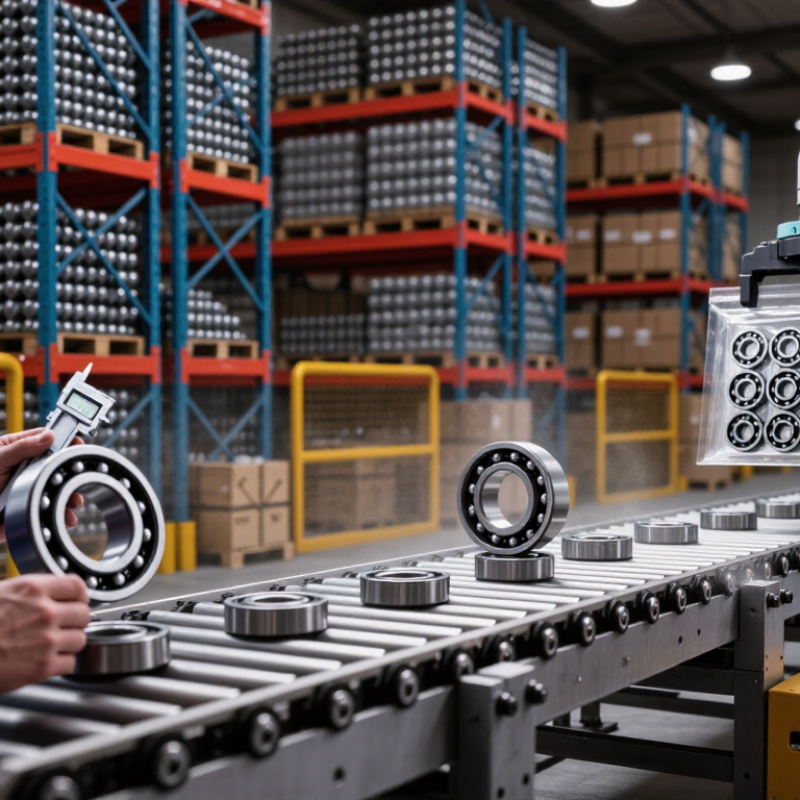
Top Real Bearing Suppliers for Global Buyers?

Bearing Types and Their Applications in Global Industries

Top Real Bearing Suppliers for Global Buyers?

Bearing Types and Their Applications in Global Industries

Global buyers should evaluate bearings by operating conditions, not catalog popularity. Deep-groove ball bearings suit electric motors, fans, conveyors, and small pumps. They handle moderate radial loads and limited axial forces. Their sealed versions reduce maintenance around dusty factory floors.

Tapered roller bearings support combined radial and axial loads. They commonly serve vehicle hubs, gearboxes, and heavy material-handling equipment. Cylindrical roller bearings carry high radial loads in steel-processing machines and industrial turbines. Needle roller bearings fit compact transmissions where installation space is restricted. Thrust bearings manage axial forces in pumps, turntables, and vertical shafts.

In field inspections, I have seen a correct bearing type fail because of poor lubrication. Selection should include load, speed, temperature, shaft fit, clearance, and contamination risks. Seals matter near water, metal dust, or washdown areas. A reliable supplier should provide load calculations, material details, tolerance data, and traceable inspection records. International buyers may also check recognized testing procedures and consistent batch documentation.

The catalog choice looked perfect. The installation was not.

Misalignment remains an underestimated problem. A spherical roller bearing can tolerate housing or shaft deflection better than many standard designs. However, it cannot correct careless mounting or excessive vibration. Buyers should request practical installation guidance, replacement intervals, and failure-analysis support. These details often reveal more expertise than a large product list.

Bearing Types and Their Typical Industrial Applications

This qualitative engineering index rates how commonly each bearing type is designed to support radial loads, axial loads, and shaft misalignment. The scale ranges from 0 to 3, where 3 indicates a primary capability. These bearing types are widely used in machinery, automotive systems, power generation, logistics equipment, construction machinery, and industrial production lines.

Key Criteria for Evaluating Reliable Bearing Suppliers

Reliable bearing suppliers are judged by evidence, not attractive catalogs. Fortune Business Insights valued the global bearing market at about USD 124 billion in 2023 and expects continued growth through 2032. However, market estimates differ across research firms. That variation deserves attention.

A capable supplier should provide material certificates, batch numbers, dimensional inspection records, and clear failure-analysis procedures. Ask whether production follows ISO 9001 and whether critical dimensions meet ISO 492 requirements. For automotive applications, IATF 16949 experience can indicate stronger process discipline. Request sample inspection reports, not only certificates. Check load ratings, operating temperature, lubrication compatibility, and seal performance against your actual equipment. A bearing that survives a laboratory test may still fail in dusty, humid, or poorly aligned conditions.

Supplier reliability also depends on delivery consistency. The 2024 Logistics Performance Index from the World Bank shows major differences in customs efficiency, tracking, and shipment reliability between countries. Discuss safety stock, lead-time variation, packaging, and replacement handling before signing a contract.

My practical mistake was trusting an average lead time; the worst-case delay mattered more. No checklist is perfect.

Tips: Compare three suppliers using the same technical specification. Verify certificates with the issuing laboratory when possible. Order a small trial batch, inspect noise and vibration, and record installation results. Review the supplier after six months, not only after the first successful shipment. Fancy paperwork can still hide weak process control.

Leading Bearing Manufacturers and Their Market Strengths

Top Real Bearing Suppliers for Global Buyers?

Leading Bearing Manufacturers and Their Market Strengths

Global buyers should judge bearing manufacturers by measurable strengths, not impressive catalogs. A capable supplier controls steel cleanliness, heat treatment, grinding accuracy, and final inspection. These details affect noise, service life, and failure rates in real machinery. During factory evaluations, buyers should review process records, calibration certificates, and sample test results. A supplier with stable production data usually offers better risk control.

Market strength differs by manufacturer type. Large producers often provide broad sizes, automated lines, and reliable export systems. Specialized manufacturers may perform better in high-temperature, heavy-load, or corrosive applications. Regional producers can offer shorter delivery routes and more flexible engineering support. However, lower pricing can hide weaker traceability or inconsistent batch quality. Ask for dimensional reports and material certificates.

Do not rely on claims alone. Request production samples from different batches. Check packaging, markings, grease condition, and surface finish. A serious supplier explains tolerances clearly and admits technical limits. That matters. I have seen purchasing teams select by unit price, then face repeated replacements within months. Even experienced buyers can overlook storage humidity, installation tools, or shaft alignment. Supplier strength includes after-sales response, documentation quality, and practical application knowledge. No manufacturer is perfect, so buyers should compare evidence, test assumptions, and leave room for improvement.

Quality Standards, Certifications, and Production Capabilities

Top Real Bearing Suppliers for Global Buyers?

Quality standards, certifications, and production capabilities separate reliable bearing suppliers from ordinary exporters. Experienced buyers should inspect more than a certificate on a website. Ask for current ISO 9001 records, material traceability, inspection procedures, and calibration reports. For automotive applications, IATF 16949 may indicate stronger process control. ISO 14001 can also show responsible environmental management.

Production capability matters just as much. Review the supplier’s forging, turning, heat treatment, grinding, and assembly processes. A capable factory should explain its tolerances clearly. Request sample inspection data, including vibration, noise, hardness, and radial clearance. Factory visits can reveal practical details, such as clean assembly areas and labeled storage racks. Still, one visit is not enough. Conditions may change after approval.

Tips: Compare certificates with audit dates. Check whether testing is done in-house. Confirm monthly capacity, lead times, packaging methods, and batch records. Ask how rejected parts are isolated. Small details often prevent large claims.

A useful supplier should also support technical communication after shipment. Engineers should answer questions with drawings, test results, and corrective actions. Some suppliers promise tight tolerances but provide incomplete reports. That weakness deserves attention. Buyers should verify performance through trial orders and field feedback, not promises alone. Availability is important, but consistent quality is harder to replace.

Top Real Bearing Suppliers for Global Buyers? - Quality Standards, Certifications, and Production Capabilities

Evaluation Dimension Recognized Standard or Reference What a Qualified Supplier Should Demonstrate Buyer Verification Evidence Importance for Global Buyers
Quality management system ISO 9001:2015 Documented control of design, purchasing, production, inspection, nonconformities, corrective actions, and continual improvement. Valid certificate issued by an accredited certification body, defined scope, audit status, and certificate validity dates. Creates a consistent process framework and improves traceability across international supply chains.
Bearing dimensional accuracy ISO 492 for radial bearings; ISO 199 for thrust bearings Manufacturing and inspection aligned with applicable tolerance classes for dimensions, rotation accuracy, and running accuracy. Inspection reports showing bore diameter, outside diameter, width, radial runout, and axial runout results. Helps ensure interchangeability, correct installation, and stable machine performance.
Load-rating calculation ISO 281 Bearing selection and rated-life calculations based on dynamic load rating, equivalent load, speed, lubrication, and operating conditions. Technical calculation sheets, product catalog data, application recommendations, and test correlation where applicable. Supports reliable service-life estimates and reduces the risk of under-sizing or over-sizing.
Static load protection ISO 76 Static load ratings evaluated for applications involving shock loads, stationary loads, oscillation, or low-speed operation. Static load calculations, application limits, and documented acceptance criteria for permanent deformation risk. Protects equipment exposed to heavy loads or frequent starts and stops.
Automotive production quality IATF 16949:2016, when automotive supply is involved Risk-based process control, product safety management, traceability, defect prevention, and customer-specific requirements. Certificate scope, process audits, control plans, PFMEA, measurement-system analysis, and production-part approval records. Provides stronger process discipline for safety-critical and high-volume applications.
Raw-material control Applicable steel specifications and supplier-specific material controls Controlled bearing steel procurement, heat-treatment records, hardness checks, cleanliness evaluation, and lot identification. Material certificates, heat numbers, hardness reports, metallurgical inspection, and retained sample procedures. Reduces premature fatigue, cracking, dimensional instability, and batch-to-batch variation.
Heat-treatment capability Process specifications defined by bearing design and material requirements Controlled carburizing, quenching, tempering, or through-hardening processes with recorded furnace parameters. Hardness distribution, case-depth data where applicable, microstructure reports, and furnace calibration records. Directly affects wear resistance, fatigue strength, dimensional stability, and operating life.
Precision manufacturing ISO 492, ISO 199, and internal process specifications CNC turning, precision grinding, superfinishing, controlled assembly, and process monitoring for raceways and rolling elements. Machine capability studies, process-control charts, surface-finish readings, roundness data, and dimensional inspection records. Supports low vibration, lower friction, accurate fit, and consistent operating noise.
Product range Applicable bearing design and dimensional standards Capability to supply commonly used deep-groove ball, angular-contact, cylindrical-roller, tapered-roller, spherical-roller, needle, and thrust bearing designs. Technical catalogs, dimensional drawings, material options, clearance classes, sealing options, and application limits. Simplifies vendor consolidation and improves compatibility across equipment platforms.
Inspection and testing ISO 17025 for competent testing laboratories Measurement systems covering dimensions, hardness, vibration, noise, torque, cleanliness, and functional performance as required. Calibration certificates, laboratory scope, gauge repeatability studies, test methods, and batch inspection reports. Improves confidence that reported results are technically valid and repeatable.
Traceability and documentation ISO 9001 documented-information requirements Lot-level traceability from raw material through machining, heat treatment, assembly, inspection, packaging, and shipment. Certificate of conformity, batch number, inspection report, packing list, and change-control records. Enables faster root-cause analysis, recall control, and customs or customer audits.
Environmental management ISO 14001:2015 Controlled environmental aspects involving energy, waste, emissions, chemicals, water, and legal compliance. Valid certificate, environmental objectives, waste-management records, and regulatory compliance documentation. Supports sustainability programs and reduces environmental compliance risk.
Occupational health and safety ISO 45001:2018 Formal hazard identification, risk control, worker training, incident investigation, and emergency preparedness. Certificate scope, safety audit results, incident metrics, training records, and corrective-action evidence. Helps buyers assess responsible sourcing and operational continuity.
Production scalability Supplier-specific capacity and delivery controls Separate production arrangements for prototypes, small batches, repeat orders, and high-volume programs, with documented capacity planning. Capacity statements, lead-time history, equipment list, production schedule, inventory policy, and business-continuity plan. Shows whether the supplier can maintain quality and delivery performance as demand changes.
Export readiness Commercial, customs, packaging, and destination-market requirements Experience with international packaging, export documents, Incoterms, labeling, moisture protection, and destination-specific compliance. Sample export documentation, packaging specification, shipping records, product labels, and agreed delivery terms. Reduces customs delays, transit damage, documentation errors, and import-related costs.
Supplier qualification decision Risk-based sourcing assessment Successful sample approval, process audit, product validation, commercial review, and agreement on quality and delivery KPIs. Signed quality agreement, approved sample report, audit action closure, first-article inspection, and ongoing supplier scorecard. Combines technical compliance, production capability, documentation, and commercial reliability before approval.

Note: Certification requirements depend on the application, destination market, and customer specifications. Buyers should verify certificate validity, scope, accreditation, and product-specific test evidence before placing production orders.

How Global Buyers Can Select the Right Bearing Supplier

Selecting the right bearing supplier requires more than comparing unit prices. A reliable supplier should explain load ratings, tolerance classes, sealing options, and expected service life. Ask for material certificates, inspection records, and batch traceability. These documents reveal whether quality control is consistent or only promised.

Request samples before placing a large order. Test them under realistic conditions, including speed, temperature, vibration, and contamination. Check whether the supplier answers technical questions clearly and provides usable drawings. Delivery performance also matters. Confirm production capacity, packaging methods, minimum order quantities, and replacement procedures in writing. A supplier may offer an attractive quote, yet weak communication can create expensive delays. I have learned that even experienced buyers sometimes overlook packaging. Rust marks inside a damaged carton can ruin an otherwise acceptable shipment.

Tips: Compare at least three qualified suppliers. Review recent inspection data, not only certificates. Ask how nonconforming products are handled. Check whether contact staff understand engineering details. A factory visit can expose gaps between procedures and daily practice. It is not always possible, but video audits can help. Keep a written scorecard for quality, response time, lead time, documentation, and total cost. Trust, but verify. Suppliers should welcome practical questions, though no supplier is perfect. Your evaluation should remain flexible when production conditions change.