Welcome to our websites!

Why Choose Pillow Bearings for Industrial Applications?

Industrial machines depend on steady shaft support, even when the working conditions are far from ideal. Dust, vibration, moisture, and changing loads can all affect bearing life. A Pillow Bearing combines a bearing insert with a housing that can be secured to a machine frame. This practical arrangement makes installation and replacement simpler in many conveying, processing, and material-handling systems.

The choice still deserves care. A unit that looks suitable on a parts list may not match the shaft diameter, operating speed, radial load, or surrounding temperature. Seals, lubrication needs, housing material, and mounting surface also matter. Small details count. For example, a misaligned base or an overlooked relubrication interval can shorten service life, even when the bearing itself is correctly specified. Manufacturer data and the actual duty cycle should guide selection; rules of thumb cannot cover every installation. That caveat is worth keeping in view.

This guide explains why pillow bearings are widely used, where their design offers practical advantages, and what to check before choosing one. It also considers common trade-offs, including maintenance access and performance in demanding environments. The goal is not to treat one bearing style as a universal fix. It is to help engineers, maintenance teams, and buyers make a more informed decision for the machine in front of them.
Why Choose Pillow Bearings for Industrial Applications?

Pillow Bearings: Structure and Operating Principles

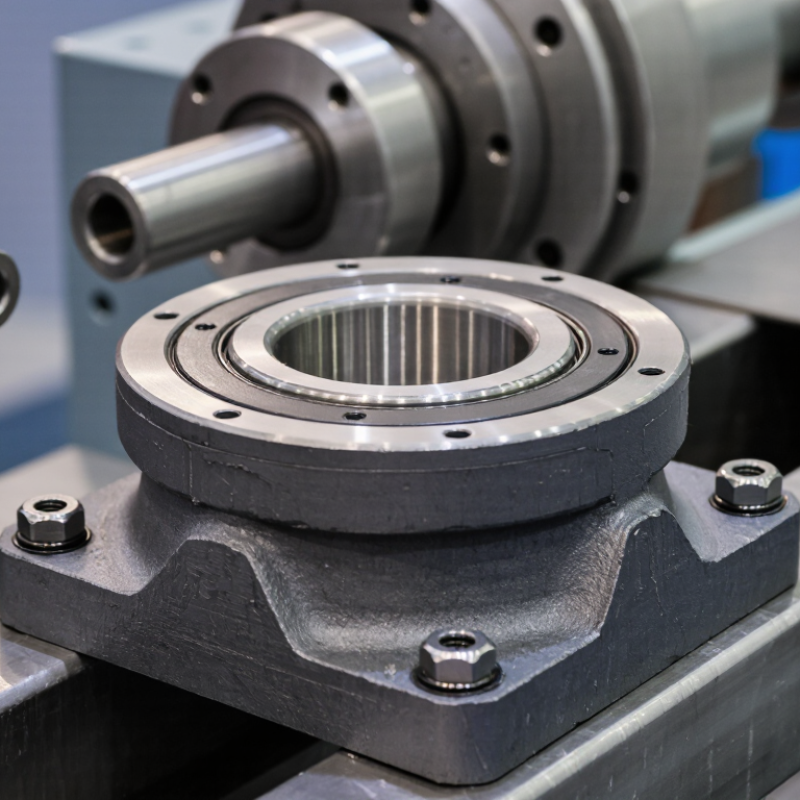
A pillow bearing combines a rolling-element insert with a rigid housing that bolts to a machine frame. The insert sits in a spherical housing seat, allowing limited self-alignment when the shaft and mounting surface are not perfectly square. Small parts matter. Seals help keep dust out, while grease reduces friction between the rolling elements and raceways. The shaft is commonly secured with set screws or a locking collar; the housing carries operating loads into the frame.

ISO 281:2007 defines basic rating life, L10, as the life that 90% of a sufficiently large group of identical bearings are expected to meet under stated conditions. For a ball bearing, the basic life calculation is L10 = (C/P)³ million revolutions, where C is dynamic load rating and P is equivalent dynamic load. This is a rating estimate, not a service-life promise. Contamination, poor lubrication, and vibration can shorten actual life.

Real life varies. In operation, technicians can check for rising temperature, unusual noise, loose mounting bolts, and grease leakage. A pillow housing may accommodate limited misalignment, but it cannot correct a badly bent shaft or an uneven base.

Load Capacity and Alignment in Industrial Systems

Pillow bearings support rotating shafts while keeping mounting simple. Their real value depends on matching load capacity to operating conditions. A belt conveyor may impose steady radial force, while a crusher can add sharp impact loads. Check shaft speed, load direction, and start-stop frequency before selecting a housing. Small details matter.

ISO 281:2007 calculates basic bearing life using dynamic load rating and equivalent load. For ball bearings, the life exponent is 3; for roller bearings, it is 10/3. The standard’s L10 life represents a 90% reliability level for a sufficiently large group of similar bearings. This is a statistical estimate, not a promise for one unit. Contamination, poor lubrication, and shock can shorten actual service life.

Alignment matters just as much. A self-aligning insert can accommodate limited angular error, but its permitted angle varies by design. Set the shaft carefully, check the base for soft foot, and allow for thermal growth. A dial indicator can reveal a small offset before the belt starts pulling unevenly. Easy to overlook. In practice, installers may trust the housing to correct too much misalignment. It cannot correct a bent shaft or unstable support. Verify the manufacturer’s published limits against the real load and installation conditions.

Why Choose Pillow Bearings for Industrial Applications? - Load Capacity and Alignment in Industrial Systems

Bearing Arrangement Typical Load Capability Alignment Behavior Common Industrial Uses Selection Considerations
Mounted insert ball bearing Suitable for light-to-moderate radial loads and some application-dependent axial load. Not generally the first choice for severe shock loading. Many insert designs accommodate small amounts of angular misalignment. The allowable angle varies by bearing and housing design. Conveyors, ventilation equipment, packaging machinery, and general material-handling systems. Check the catalog dynamic and static load ratings, shaft-locking method, speed limit, seals, and lubrication requirements.
Mounted spherical roller bearing Often selected for high radial loads and demanding conditions such as shock or vibration. Axial capacity depends on the bearing design and load direction. The spherical rolling-element arrangement can accommodate misalignment within the limits specified for the particular assembly. Crushers, heavy conveyors, mining equipment, and other high-load machinery. Consider shock factors, internal clearance, shaft and housing rigidity, lubrication, and the required service life.
Plain or sleeve-type pillow bearing Supports radial loads through sliding contact; suitability depends strongly on material, lubrication, speed, temperature, and operating duty. Usually requires careful shaft alignment unless the specific bushing design is made to accommodate angular movement. Low-speed shafts, oscillating mechanisms, and applications where simple construction or quiet operation is useful. Verify the allowable pressure–velocity limit, lubrication method, wear allowance, and compatibility with the shaft material.
Fixed and floating bearing positions A locating position controls shaft position; a non-locating position allows axial displacement where the design provides for it. Correct arrangement helps prevent thermal expansion from creating unintended axial preload or excessive load. Long shafts, hot-running equipment, and systems where temperature changes affect shaft length. Confirm which bearing position locates the shaft and how axial movement is accommodated; not every pillow-block assembly is designed to float.
Load-rating and life check Use the selected bearing’s published dynamic rating C, static rating C0, and equivalent bearing load P. Misalignment can increase internal stress and reduce service life, even when the bearing can accommodate some angular error. All applications requiring a defined reliability or maintenance interval. For basic rating life, use L10 = (C/P)p × 106 revolutions, with p = 3 for ball bearings and p = 10/3 for roller bearings. Apply appropriate corrections for actual operating conditions.

Load capacity and permissible misalignment are specific to the bearing, housing, fit, and operating conditions. Confirm values in the relevant technical catalog and validate the complete mounted assembly for the application.

Key Advantages of Pillow Bearings for Industry

Pillow bearings combine a housed bearing and mounting base in one practical unit. Their design simplifies installation on conveyor frames, fans, pumps, and other industrial equipment. A mounted housing can also make inspection and replacement easier, especially where access is limited. That matters during a busy shift. Their self-aligning design accommodates minor shaft misalignment, reducing stress caused by small mounting errors. It is not a cure for poor alignment.

Tips: Check the shaft size, load, speed, and operating temperature before selecting a bearing. Confirm that the mounting surface is flat and the housing bolts are secure. Follow the lubrication schedule. A simple inspection log can reveal rising noise or heat before a failure stops production.

The main advantages depend on the application. Sealed units can help keep dust and moisture away from rolling elements, while replaceable components may reduce maintenance time. Still, seals do not make a bearing immune to contamination, and over-lubrication can create heat. Selection should match the actual load and environment, not just the catalog dimensions. A little caution here pays off.

Why Choose Pillow Bearings for Industrial Applications?

Key advantages of common self-aligning pillow block units

Pillow block units combine a mounted housing with a bearing insert to support a shaft. Many insert designs accommodate limited misalignment, which can simplify installation. The chart shows typical design features—not performance ratings; load capacity, sealing, and allowable misalignment depend on the specific unit.

Common Industrial Applications of Pillow Bearings

Why Choose Pillow Bearings for Industrial Applications?
Common Industrial Applications of Pillow Bearings

Pillow bearings support rotating shafts in conveyor lines, fans, pumps, and packaging equipment. Their bolted housings make alignment and replacement practical on a factory floor. In bulk-material handling, they often support conveyor rollers and drive shafts. At transfer points, abrasive dust can enter the housing, so seals and maintenance intervals matter. Dust changes everything.

Steel production illustrates the scale of equipment involved. World Steel Association’s World Steel in Figures 2024 reports 1,892.2 million tonnes of crude steel produced globally in 2023. Pillow bearings may serve auxiliary conveyors, ventilation fans, and material-handling machinery in steel plants. The report measures steel output, not bearing use; it provides context, not a direct demand estimate. USGS estimated global cement production at 4.1 billion tonnes in 2023, another industry reliant on conveyors and fans. Bearings near hot kilns need careful placement and suitable temperature ratings. A familiar housing is not automatically the right choice.

Agricultural machinery, food-processing conveyors, and water-treatment equipment also use pillow bearings. In washdown areas, corrosion resistance and sealing deserve attention; in fields, shock loads and dirt complicate the selection. Check shaft size, operating speed, load direction, and lubrication access against actual conditions. It is easy to specify a bearing from a catalog and overlook the messy details. That happens more often than it should.

Factors for Selecting and Maintaining Pillow Bearings

Pillow-bearing selection starts with the shaft, not the housing shape. Match the bore size, radial load, speed, and expected misalignment to the machine’s duty. A dusty conveyor needs effective seals; a washdown line needs corrosion-resistant materials and compatible grease. Check the base stiffness and bolt pattern, too. A flexible frame can distort the housing and create uneven contact. Small details matter.

Maintenance begins at installation. Clean the shaft, confirm alignment, tighten fasteners to the specified torque, and avoid driving the bearing into place with blows. During operation, record vibration, temperature, noise, and relubrication intervals. A rising temperature or new rumble deserves inspection. The U.S. Department of Energy’s Operations & Maintenance Best Practices Guide (2010) reports predictive-maintenance savings of about 8–12% over preventive maintenance. That figure covers maintenance programs broadly, not pillow bearings alone. Still, condition checks can help reveal lubrication loss or looseness early. Not every warning is obvious. Grease quantity is easy to misjudge, and overgreasing can raise heat. Revisit intervals after changes in dust, moisture, or load rather than trusting a calendar blindly.